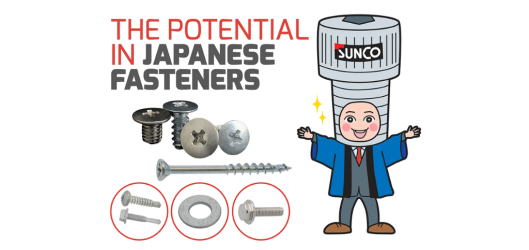
Knowledge booster: If Japanese fasteners are shrouded in mystery, then Osaka, Japan-based fastener specialist SUNCO has precisely the kind of expert knowledge to shed light on this potentially profitable area with insights into how they can be a handy area of business expansion. SUNCO explains all to Torque Magazine and also about how the firm can be a valuable partner.
Reliable, durable and high quality: Japanese fasteners have a good reputation, but lack of familiarity can make fasteners from Japan into your product mix. But, help is at hand from Osaka's SUNCO, which has some gateway offers to make it a feasible and attractive possibility (more of that later).
Torque Magazine quizzed SUNCO on some of the myths about stocking Japanese fasteners and for a refresher on some of the key original fasteners from that nation. First up, what about that positive reputation that Japanese fasteners have?
A SUNCO spokesperson tells Torque Magazine: "As long as a product is standardised, and the same manufacturing equipment is used, it is no longer particularly difficult to keep both materials and finished products within the specified standards. "However, many manufacturers still place limited emphasis on product stability and the concept of PPM, and do not conduct manufacturing with PPM targets as a fundamental premise. In addition, there are aspects such as the precision and uniformity of heat treatment, as well as mould technology - specifically the accuracy of metal flow - that cannot be fully evaluated through standards and inspection items alone. In these "plus-alpha" areas that go beyond formal specifications, Japanese manufacturers demonstrate a high level of capability.
"This can be attributed to the diligence of Japanese professionals and the high-quality expectations within the domestic market. While products may appear identical at first glance, closer examination often reveals meaningful differences. Ultimately, which of these differences are valued is a decision left to the customer."
QuaStix
Original fasteners produced in Japan may be something of an unknown quantity to many, so SUNCO is taking us on a tour through some of the key models, including the QuaStix line of screws, which are particularly appropriate for product miniaturisation and space saving designs...
"QuaStix is a screw that features a cross recess while offering a structure designed to prevent cam-out. As a result, it is increasingly being adopted by customers who require screws that can accommodate high tightening torque despite having a low head height.
"In general, reducing the head height of a screw makes the tool-engaging recess (cross recess) shallower, which increase the likelihood of cam-out - where the driver slips out during tightening. As a countermeasure, recess shapes that are less prone to cam-out, such as hex sockets, are sometimes used. However, due to the characteristics of straight-sided holes, the recess in low-head screws becomes significantly smaller, making it difficult to apply high tightening torque. This has, in some cases, become a barrier to further miniaturisation and thinning of products.
"QuaStix focuses on the advantage of cross recesses, which allow for a relatively large recess even in low-head screws, and incorporates a proprietary cross-recess design. This structure suppresses cam-out while maintaining a low head height, achieving high recess strength without the drawbacks typically associated with conventional cross-head screws.
"Although a dedicated driver is available, more than 90% of users actually use standard cross-head tools. The fact that no tool change is required also makes QuaStix easy to adopt in terms of design modifications and implementation on production lines, and is one of the key factors behind its growing adoption."
QuaStix properties
The advantages of QuaStix extend beyond its resistance to cam-out:
1. High tightening stability
QuaStix provides excellent driver engagement and is often praised for its ability to securely hold screws during fastening - even in the case of stainless steel screws, which cannot be lifted magnetically. This secure engagement helps suppress wobbling during installation and is also used as an effective measure to prevent fastening errors caused by angled or misaligned tightening.
2. Standardisation of driver size
Unlike hex socket screws, QuaStix allows the same driver size to be used across multiple screw sizes. This reduces the burden of tool management for users and minimises the need for tool changes, contributing to improved work efficiency on production lines.
QuaStix applications
QuaStix is increasingly being adopted across a wide range of industries where the combination of a low head profile and high tightening torque is required.
1. Housing equipment and building materials
In this field, QuaStix is valued for its ability to prevent cam-out when using standard cross-head drivers. Adoption is expanding not only for low-head screw specifications, but also for standard head geometries, where it is used to prevent screw drop-off caused by cam-out or poor driver engagement during installation.
2. Electronic and precision equipment
As products continue to become thinner and more compact, QuaStix is used in both internal housings and exterior components where strict limitations on screw head height apply. For No. O driver size, there is an established track record of use starting from M1.4 screws.
3. Automotive-related components
While the trend toward lightweight and space-saving designs has driven the use of lower-head screws, there are cases where insufficient recess strength prevents even hex socket designs from withstanding the required tightening torque. As a solution to these challenges, the adoption of QuaStix has been increasing.
4. Multi-sector applications
QuaStix is not limited to any specific industry, but it is a suitable choice for wherever there is a need to reduce head height without compromising tightening torque or workability, regardless of the application field.
More original Japanese fasteners
ONIBA PIAS
At many construction sites, the generation of sparks is prohibited. ONIBA PIAS product enables steel plates to be fastened together without generating sparks. It can be installed without pre-drilling and is suitable for fastening steel plates with a total thickness of up to 12 mm.
EIGHT LOCK WASHER
This is an innovative product in which the washer itself is angled. By utilising the inclined bearing surface, it provides a loosening-prevention effect when used with standard commercially available bolts.
Flat flange bolt
This bolt features a flat head design that prevents water from pooling. It has a proven track record in applications such as commercial kitchen equipment and is an ideal product for environments where hygiene is a concern.
Japanese fasteners and standards
Quality standards and certifications like ETAs are obviously key to a lot of European distributors, for instance those operating in the construction sector. Some may overlook Japanese original fasteners and assume they don't adhere to ETA or ISO standards... but is that a misconception?
"Some parts may be correct, while others are likely inaccurate," explains SUNCO. "As you mentioned, very few Japanese manufacturers have obtained ETA certification. However, this does not necessarily mean that they do not comply with ETA-related requirements; rather, many simply have not gone through the certification process.
"On the other hand, many Japanese manufacturers are ISO-certified, and ISO compliance is relatively common.
"Japanese products are known for their very high performance and precision, but most do not have ETA certification. One of the reasons for this is that these products are optimised for Japanese construction practices, which may not fully align with ETA standards. In addition, ETA certification was not required by their existing markets, and therefore manufacturers did not proceed with obtaining it.
"Furthermore, in cases where products are manufactured as OEM and sold in Europe, there are situations where the European distributor or brand owner obtains the ETA certification and sells the products under their name."
Trends: Coping with powerful forces
As sectors have evolved, so too have their requirements of fasteners, for instance more powerful tools, like impact wrenches, placing fasteners under greater stress. SUNCO explains: "In Japan [as in other territories], the number of users adopting high-power impact drivers rated at 18V and 40V has been increasing.
“Initially, the use of such high-power impact drivers frequently resulted in head breakage when driving wood screws and self-drilling screws. For this reason, screw manufacturers traditionally discouraged the use of high-power impact drivers. However, in recent years, as construction schedules have become shorter and greater efficiency is required, development has progressed on both socket bits and screws capable of withstanding higher torque."
Original screws developed in Japan that answer that need include:
TAPIX V
- Equipped with a special flexible joint that withstands even high-torque 40V-class tools and absorbs impact during tightening.
- The special blade (fin) powerfully ejects wood chips, reducing excessive load and extending battery life.
SLIPPER
By developing and adopting an original special recess design, this screw protects against head breakage and bit chipping. Even when tightened with hyper torque, once the head is seated on the base material, the bit cams out if excessive torque beyond the appropriate level is applied.
ONIBA PIAS
This SUNCO-original product features a specially designed cutting tip combined with a highly lubricative surface treatment that is resistant to frictional heat. By maximising cutting speed, it fully utilises the power of high-performance impact drivers. While conventional self-drilling screws were not suitable for use with impact drivers, Oniba PIAS enables faster penetration of thick steel plates when driven with high torque. It is also capable of penetrating stainless steel (A2) plates, which are normally difficult or impossible to drill through, making it a highly capable solution.
Trends: Sustainable and innovative materials
Sustainability is a topic driving change and innovation throughout the supply chain, including building materials. CLT (cross laminated timber) is one relatively newly developed material that's more sustainable than some traditional materials, and new materials can place different requirements upon fasteners.
SUNCO picks up the topic: "In the construction sector, there has been a growing adoption of long, high-strength screws for connecting CLT (cross-laminated timber) floors and walls, as well as square and hexalobular recess screws capable of withstanding high torque.
"A key challenge lies in developing versatile screws that can securely fasten new materials together with reinforcing steel plates. At the same time, efforts are underway to reduce CO2 emissions during screw production and to contribute to sustainability by accelerating installation speed.
Trends: supply chains
It would be remiss to avoid the topic of supply chains, which have been in the spotlight particularly in the past six years. Are some European and UK firms wary of growing the ranges of fasteners they supply that are made far away?
SUNCO is pragmatic on the topic: "Regarding supply chain challenges, these are not decisions we can make on behalf of our customers. However, we would be glad if SUNCO could be considered as an additional option within existing supply chain choices.
"If current suppliers are meeting your needs, there is no need to change. We aim to support customers by addressing niche requirements, such as JIS screws, Made in Japan products and small-quantity orders (even single pieces, or "BARA"). For items stocked in our inventory, we can ship via air within three to four days of receiving your order.
"The market for JIS screws in Europe is very niche. However, many types of Japanese products, such as industrial machinery, are not only used in Europe but are also manufactured and sold there. There is certainly demand in the aftermarket as well. While individual orders may seem small and less profitable at first glance, if 100 customers each place an order of €100 per month, this would amount to €120,000 in annual sales.
"There is no need to significantly increase your own inventory of JIS screws. By simply promoting in your market that "we stock JIS screws on your behalf and can ship your required quantities within three to four days", you can start in a low-risk manner. From there, you can gradually determine the product line-up.
"We believe that SUNCO can be a valuable partner in helping expand your business opportunities."
If you're ever in the area...
"We would be delighted to welcome your readers to Higashi-Osaka, the birthplace of Japanese screws, and invite you to visit our logistics centre," SUNCO tells Torque Magazine. "We warmly welcome visits. We hope you will also have the opportunity to experience the warmth and hospitality of the people of Osaka, enjoy the region's renowned culinary culture - often referred to as "Tenka no Daidokoro", or "the nation's kitchen" - and explore its many fascinating sightseeing spots.
"At SUNCO Industry, which handles over two million items, we carry all the Japanese original products introduced in this presentation. In addition to these products, we offer a wide range of other Japanese original items. Please feel free to contact us via our website: www.jisscrew.com
Our BARA service also accommodates small-quantity shipments, allowing us to ship even a single screw. For inquiries regarding Japanese original products or JIS (metric) screws, please contact SUNCO Industry.