From heavy manufacturing to energy and defence, secure bolted joints underpin Europe’s industrial resilience. Advanced tensioning is playing an increasingly central role in delivering long-term safety, reliability and performance. Nord-Lock’s Head of Sales Tensioning Europe, Olivier Gaillard, explains all…
Across Europe’s power stations, offshore platforms, manufacturing plants, rail networks and defence facilities, bolted joints quietly carry enormous responsibility. When these connections fail, the consequences extend far beyond maintenance costs – disrupting operations, damaging assets and placing safety at risk.
In critical industries, bolting is not a commodity, but a safety decision. Every joint represents an investment in people, equipment and long-term reliability. Safe guarding that investment is at the heart of everything we do.
Since its founding in 1982, Nord-Lock Group has grown into a global specialist in secure bolting technologies, employing more than 700 people worldwide. Our portfolio spans wedge-locking washers, pivot pin systems and specialised fasteners. In Europe, a key focus is tensioning – particularly through Superbolt® mechanical tensioners and Boltight® hydraulic systems.
Together, these technologies address one of engineering’s most persistent challenges: achieving accurate, consistent preload in large, safety critical joints (explains Olivier Gaillard, Head of Sales Tensioning Europe).
Meeting evolving industrial demands
Europe’s industrial landscape is evolving. Conventional power generation now operates alongside renewables. Infrastructure is ageing. Regulatory scrutiny is increasing. Across sectors, asset owners are under pressure to extend service life while improving reliability.
In industries such as power generation, mining, defence and heavy manufacturing, maintenance and durability are non-negotiable. Many assets operate in remote or restricted environments, where access is limited, down time is expensive and tolerances are tight.
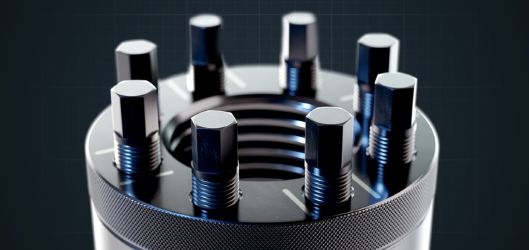
Superbolt mechanical tensioners enable large diameter bolts to be tightened using standard hand tools, breaking high preload requirements into smaller, controlled increments through multiple jackbolts. This allows operators to achieve precise preload without relying on heavy hydraulic torque equipment.
Boltight hydraulic tensioners, by contrast, stretch the bolt directly using controlled hydraulic pressure. By reducing the friction variables associated with torque tightening, hydraulic tensioning delivers uniform and repeatable preload across critical flanges and pressure assemblies.
The result is improved load distribution, reduced fatigue risk and greater long-term joint integrity – outcomes that directly support asset longevity and operational confidence, explains Olivier Gaillard, Head of Sales Tensioning Europe.
Combining local support with global reach
Flexibility is central to our European strategy, reinforced by a strong regional manufacturing footprint.
We support customers ranging from local engineering firms to multinational operators working across multiple territories. This capability is strengthened by European production facilities, including Superbolt’s manufacturing site in Switzer land and Boltight’s hydraulic tensioning operations in the UK.
This regional presence provides shorter lead times, closer technical collaboration and greater supply chain stability – increasingly important in today’s market environment.
Supported by a specialist EMEA tensioning team and global production resources, we operate as both a regional partner and an international supplier. In practice, this may mean providing urgent support during a planned shutdown, or working alongside customers within multiyear infrastructure programmes.
Reliability matters – in our products, our processes and our partnerships.
Engineering confidence into critical joints
Across Europe, sectors as varied as industrial infrastructure, structural engineering, heavy machinery and energy rely on advanced tensioning for the same reason: predictable performance.
In any application with critical joints, repeatable preload is more than a technical specification. It is essential to operational confidence.
Mechanical tensioners reduce operator strain and improve safety by lowering required torque forces. Hydraulic systems provide controlled, simultaneous bolt stretching that is less sensitive to lubrication or surface variation. Both approaches are designed to remove uncertainty from bolted assemblies. Our approach also emphasises close collaboration with customers, from early technical consultation to long-term service support. Each application is different, and effective tensioning depends on understanding operational realities as well as engineering requirements.
Reliable bolting is foundational to safe, efficient industry. It requires both the right technology and the right support.
As European industry continues to prioritise resilience, advanced tensioning is becoming central to engineering practice – ensuring that critical joints remain secure not only at installation, but throughout decades of service.