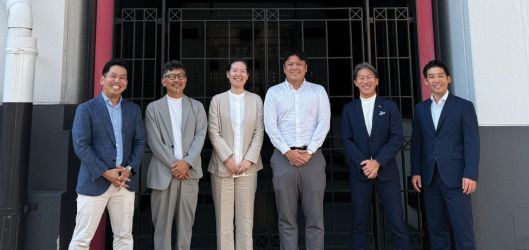
In the summer of 2025, SUNCO INDUSTRIES CO., LTD. held a roundtable discussion with four of its suppliers, centred around the theme: “Discussing the Present and Future of Overseas Business.” Participants shared their insights on the current state and outlook of global expansion in the fastener industry...
Could each of you briefly introduce your company?
Mr. Ando: ANSCO Co.,Ltd. specialises in manufacturing slim socket screws. We have facilities in Aichi, Saga, Japan, and Thailand. Most of our clients are in the machine tool and automotive industries. Compared to last year, demand from machine tool manufacturers has been relatively strong and the automotive sector remains steady.
Mr. Taniguchi: NAKAUMI INDUSTRIES Co.,Ltd. is a manufacturer specialising in fully threaded rods. We produce products from 3mm to 64mm, mainly in steel and stainless steel. We have four factories in Japan and one in Vietnam. Recently, the construction market has been a bit sluggish, but our business in Europe has been relatively strong and our Vietnam facility has been quite busy.
Mr. Hashimoto: Unytite Corporation was founded in 1946 and manufactures high-strength bolts, grade 10.9 bolts, nuts and other related products for a variety of industries. Our headquarters is in Kobe, and we have overseas offices in the US and China. While the construction and civil engineering sectors are slowing down, the shipbuilding market is still performing fairly well. Due to the high proportion of automotive clients in China, business there is weaker than in Japan, but our US operations remain solid.
Mr. Murakami: NIPPON FASTENER CORPORATION manufactures CHQ steel wires, high-tension bolts, hex socket bolts and more. We operate factories in Tsurumi (Osaka) and Shiga. Unlike the others here today, we haven't yet expanded overseas. Our current customer base is mainly domestic, but we’re beginning to look toward international markets for future growth.

As you’ve engaged in global business, what strengths have you identified in your company or in Japanese firms more broadly?
Mr. Ando: I’d say Japan’s technical expertise. One moment that stood out to me was when we showed our overseas partners screws in the 1mm range – they were genuinely amazed. Something that feels routine to us can have a huge impact abroad. I also think our reputation for reliability is a strength. We provide after-sales service, which contributes to the trust our clients place in us.
Mr. Taniguchi: When we try to sell our products overseas, the first thing we often hear is, “Japanese products must be expensive, right?” It’s clear that Japanese goods are perceived that way. On the other hand, when dealing with things like export/import documentation—especially in Europe – we’re sometimes trusted more because we’re a Japanese company.
Mr. Hashimoto: I agree with the previous points. The high quality of Japanese products is a major strength. Also, Japanese companies are generally seen as reliable partners. In international business, issues like payment and trust are crucial, and I feel Japanese firms are highly rated in those areas. However, one drawback is the slow decision-making process within many Japanese companies.
Mr. Murakami: I’ve noticed differences in manufacturing approaches. Overseas, the attitude tends to be that it’s fine to sort out defects during final inspections, even if the production process isn’t perfect. In contrast, Japanese manufacturers aim to prevent defects right from the production stage. That results in a higher level of quality overall. While marketability is another issue entirely, Japan excels in its accumulated know-how and skilled human capital.
Mr. Takada: I believe one of our strengths at Sunco is the breadth of our product line-up. Thanks to the support of our suppliers, we can ship quickly after receiving an order, which is a big advantage for overseas customers and one reason they choose us. We also get positive feedback on our fast response times and we now receive inquiries from overseas almost every day.
What do you think can be done to increase global sales of Japanese fasteners?
Mr. Taniguchi: Speaking from the perspective of fully threaded rods, price is still a key factor. It's difficult to mass-produce inexpensively in Japan, so our overseas facility focuses on high-volume production. The more we produce, the more cost-effective it becomes, which helps us stay competitive globally.
Mr. Hashimoto: Japanese raw materials are indeed expensive by global standards. But with the yen so weak right now, I question whether price is the only issue. There are also challenges related to standards—many companies can handle JIS specifications, but not ISO. That limits us. In the U.S., tackling niche markets could yield big opportunities—even enough to start a new company. We once had a product imitated right after letting a U.S. patent expire. So besides strong development capabilities, we need to bolster our sales strategies too. I still see a lot of potential in Japanese fasteners.
Mr. Murakami: Expanding sales channels is a major challenge for manufacturers like us, so we rely heavily on trading companies like Sunco.
Ms. Hiraoka: We don’t have overseas branches, so it’s tough to actively visit and sell globally like we do within Japan. That’s why we put our energy into promotional activities—raising awareness that there are so many unique fastener companies in Japan and that Japanese products can be competitive. We hope our magazine, SOCKET BOY, helps us reach a wider audience. Our efforts in promotion rely heavily on the technological capabilities of our suppliers.
Mr. Murakami: In other words, you're arming the trading company with the right “weapons.”
Ms. Hiraoka: Exactly. While we specialize in JIS-standard products, we don’t yet offer enough variety in other international standards. Sometimes we can’t respond well to customer requests, but we always aim to be better prepared next time. That said, it’s hard to decide how far to expand our range.
Mr. Taniguchi: So even for different standards like DIN, you try to be ready to respond next time?
Mr. Takada: Yes, as much as possible. We can’t handle everything, of course, but when a customer takes the time to inquire, we want to meet their expectations. Even if we can't carry all sizes, we’d like to stock at least some, so they’ll come back to us. Talking with everyone today has made me realize just how important “awareness” is. There are so many amazing Japanese manufacturers, but overseas buyers don’t know them. Many assume Japan is too far and too expensive. But once they do know us, they often take an interest—so spreading awareness is vital.
Mr. Ando: I agree. First, we need to get users to know who we are. Then we need to build systems that let them get our products quickly when they need them. I think Sunco’s Socket Boy magazine is a very effective strategy in that regard. Going forward, strong collaboration between manufacturers and trading companies will be key. By leveraging each other’s strengths, we can boost Japan’s competitiveness globally and sell more fasteners.
On the flip side, what areas do you think Japanese companies still fall short in?
Mr. Hashimoto: Many Japanese firms assume they can’t compete on price, but maybe they’re just not promoting themselves enough. Despite the large number of fastener manufacturers in Japan, many mid-career and younger overseas professionals don’t know they exist. There’s also a common misconception that Japan only makes automotive fasteners, when in fact, we produce a wide variety of industrial products too. I think it’s partly due to lack of overseas experience and know-how in self-promotion. That’s why, as Mr. Ando mentioned, collaboration between manufacturers and trading firms to build an overseas strategy is so promising.
Mr. Taniguchi: That’s true. Not many people associate Japan with fasteners. I once visited a company in Italy that I thought was just a trading firm, but they were also manufacturing. It’s the same as how we don't usually associate Italy with fasteners—they’re known for fashion. It goes both ways.
Mr. Murakami: Even something as simple as our website is an issue—we only have it in Japanese. If your messaging is only in Japanese, it’s naturally hard to reach an international audience. We definitely need to adapt to more global languages.
As you expand internationally, could you share the challenges you’ve encountered when doing business with overseas companies and the issues you foresee going forward?
Mr. Ando: I feel that “people” are a key challenge. Overseas, cultural and customary differences can make communication difficult, which in turn can hinder smooth business operations. Another issue is securing domestic talent who are eager to engage in international business.
Mr. Taniguchi: In Vietnam, navigating local laws and tax regulations is extremely challenging. Recently, anti-corruption efforts there have slowed administrative decision-making. That means we often have to make judgments ourselves regarding legal and tax issues. While these challenges are numerous, we see them not as problems but as opportunities for growth—and we’re committed to tackling them proactively.
Mr. Hashimoto: For our overseas operations, a significant issue is placing local leaders at the top—having management run by local nationals to drive business in their own country. That means investing in training and developing our people on the ground is critical.
Mr. Murakami: Launching exports marks our next challenge, but it’s essential to monitor political risks. In the past, we operated a nail manufacturing subsidiary in South Korea that exported mainly to the U.S.—our only foray abroad. But when South Korea’s political system changed, local law required local nationals to own the company, forcing us to withdraw. That experience showed us the importance of staying watchful about political developments.
Mr. Takada: Our greatest challenge was engaging team members, who had only domestic experience, to think internationally. Our company has more than 70 years of history in Japan, but our export business is only in its fourth year, which initially caused confusion among staff. To help, we built systems minimizing the gap between domestic sales and exports and worked hard to raise internal awareness of the export business. As a result, exporting is becoming embedded in our culture, and staff attitudes are shifting positively. We’re now even targeting exports to contribute to 1 % of total revenue. A future challenge is handling security and compliance—managing risks carefully even as we expand export operations.
Mr. Hashimoto: Even in my own company, it's not easy to instill an international mindset across domestic teams. From experience, I know some departments feel—because they have little overseas contact—that "this doesn’t concern me." That makes me appreciate Mr. Takada’s accomplishments even more. To increase global visibility among employees, we’ve adopted fully overseas‑manufactured forging machines. That way, employees naturally interact with overseas vendors in English, raising their awareness of international operations.
Finally, could you share your thoughts on "Japan as seen by the world, the world as seen from Japan, and the challenges the fastener industry will face going forward"?
Mr. Hashimoto: I hate to sound pessimistic, but Japan’s geographic isolation seems to have driven a tendency to complete business domestically—even in the fastener sector. As Japan’s population continues to age and shrink, the market will likely contract, driving consolidation through M&A—and potentially opening the door for foreign companies to enter Japan seriously. I think that isn’t an unlikely scenario.
Mr. Ando: The challenges facing Japan’s fastener industry mirror those confronting SMEs in Japanese manufacturing—aging, labor shortages, and so on. That means recruiting and securing strong distribution channels are key. As the market shrinks, recruitment will become even harder. That makes it vital to communicate a shared vision and operate with colleagues united around common goals.
Mr. Takada: Reflecting on ideas like Peter Clarke’s Law, changes in industry structure, an aging population, a shrinking domestic market, and potential overseas players entering Japan could reshape the fastener industry's makeup. Looking ahead, adapting means strengthening marketing, expanding into new markets, and emphasizing Japan’s remarkably high craftsmanship on the global stage. Viewed positively, this is the moment for us to unite and showcase our manufacturing excellence to the world.
Ms. Hiraoka: To adapt to industrial shifts, it's crucial to offer customers strong added value. One example is our ability to ship screws individually or in mixed configurations—“BARA.” By adding value to products supplied by domestic manufacturers, we can give Japanese fasteners a compelling competitive edge—and I believe that will become increasingly important.
From Sunco Industries’ perspective, are there any requests or messages you’d like to convey to your suppliers regarding international business?
Mr. Takada: We’re seeing more and more inquiries from abroad that fall outside what we can handle alone—things like specific standards or tight delivery timelines. We’d greatly appreciate your support in those areas. At the same time, we plan to continue ramping up our promotion to overseas markets to generate more inquiries—creating mutual benefits for us and our suppliers. Also, just as overseas manufacturers build facilities using Japanese screws, there are projects in Japan using non-Japanese fasteners. We’d like to win more orders in those areas. In fact, some foreign firms have already asked us to help with product substitutions. We’d like to share such information with our suppliers so we can boost both our sales together.
This article was provided by Socket Boy magazine, with editorial support from KINSAN FASTENER NEWS. SOCKET BOY magazine is a free publication issued by SUNCO. Since its launch in 2024, it has consistently delivered a wide range of content, including the latest news about the fastener industry, interviews with suppliers, and the culture and history of Higashi Osaka City, Japan's manufacturing hub. Furthermore, SUNCO plans to launch the SOCKET BOY magazine website in autumn 2025. In addition to the magazine PDF, exclusive articles only available online will be posted. This content will be shared globally, targeting industry professionals, manufacturing enthusiasts and anyone with a curious spirit.